Scientific R&D
Matflow
Physics-validated AI for batteries, formulations, and materials.
Experimental rows in, ranked candidates out. Matflow turns sparse lab data into working models, cost-aware candidate rankings, and publication-grade dossiers — with every number traceable to its source run, engine, and evidence class.
Free accounts include every module. Academic researchers with institutional email domains get extended limits automatically.
0.41–0.95
Held-out R² across public benchmark datasets
0.95
Leave-family R² on the bundled demo corpus
6
Public gold suites, reproducible end to end
Metrics published on matflow.celaron.com and its public benchmarks hub; confirmed against the Product Hunt launch post.
Inside Matflow
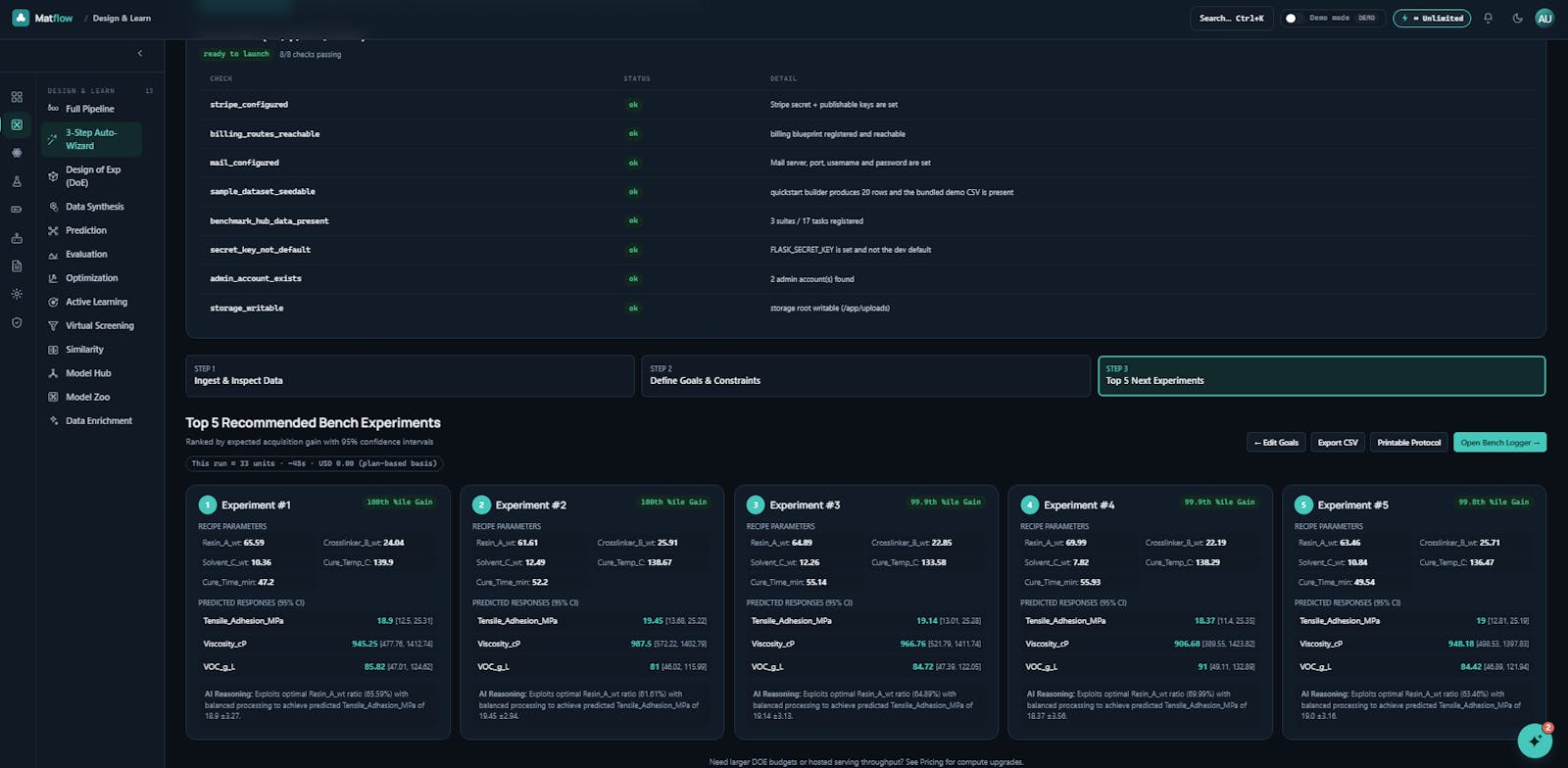
The real interface, with honest labels.
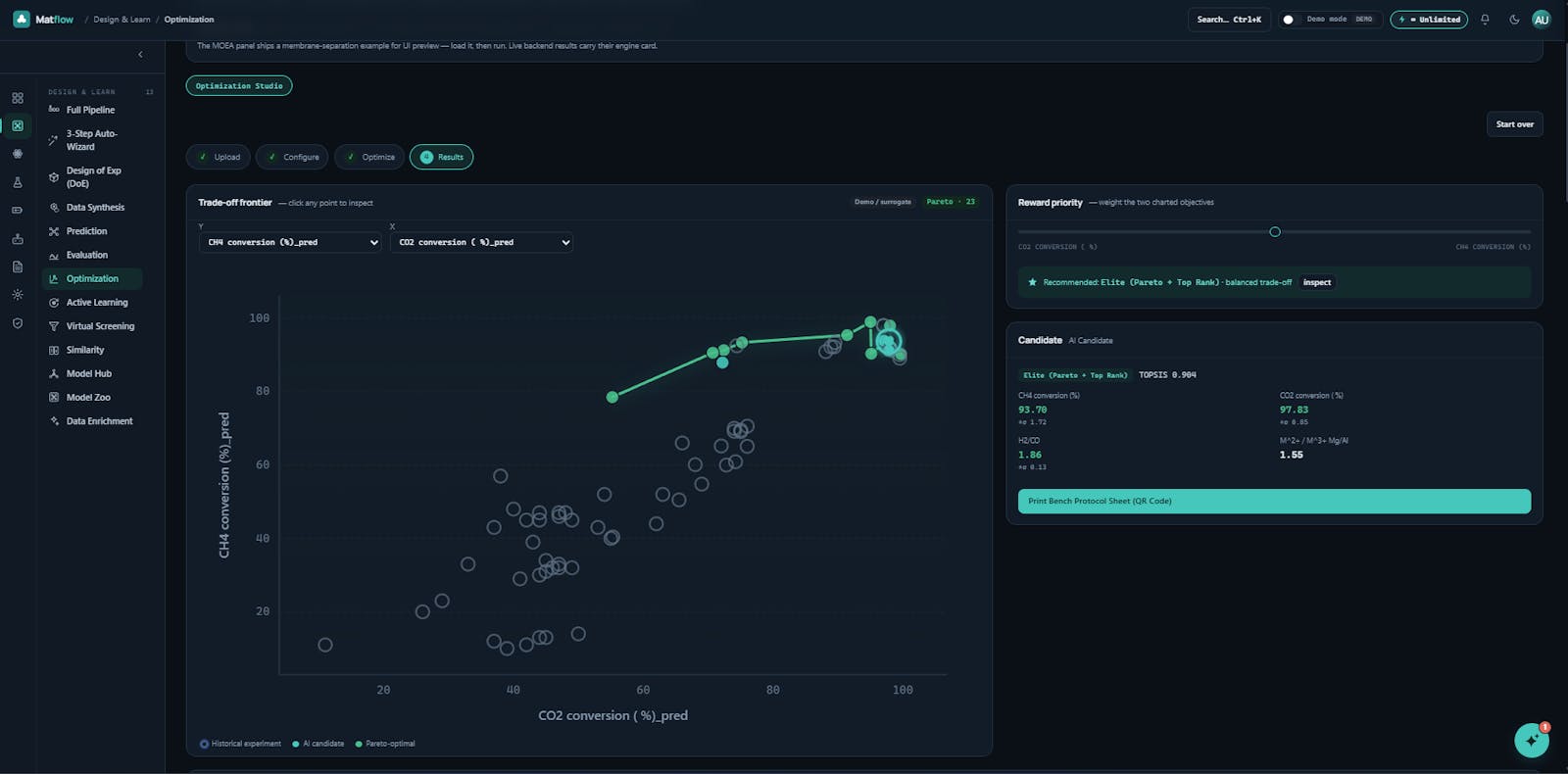
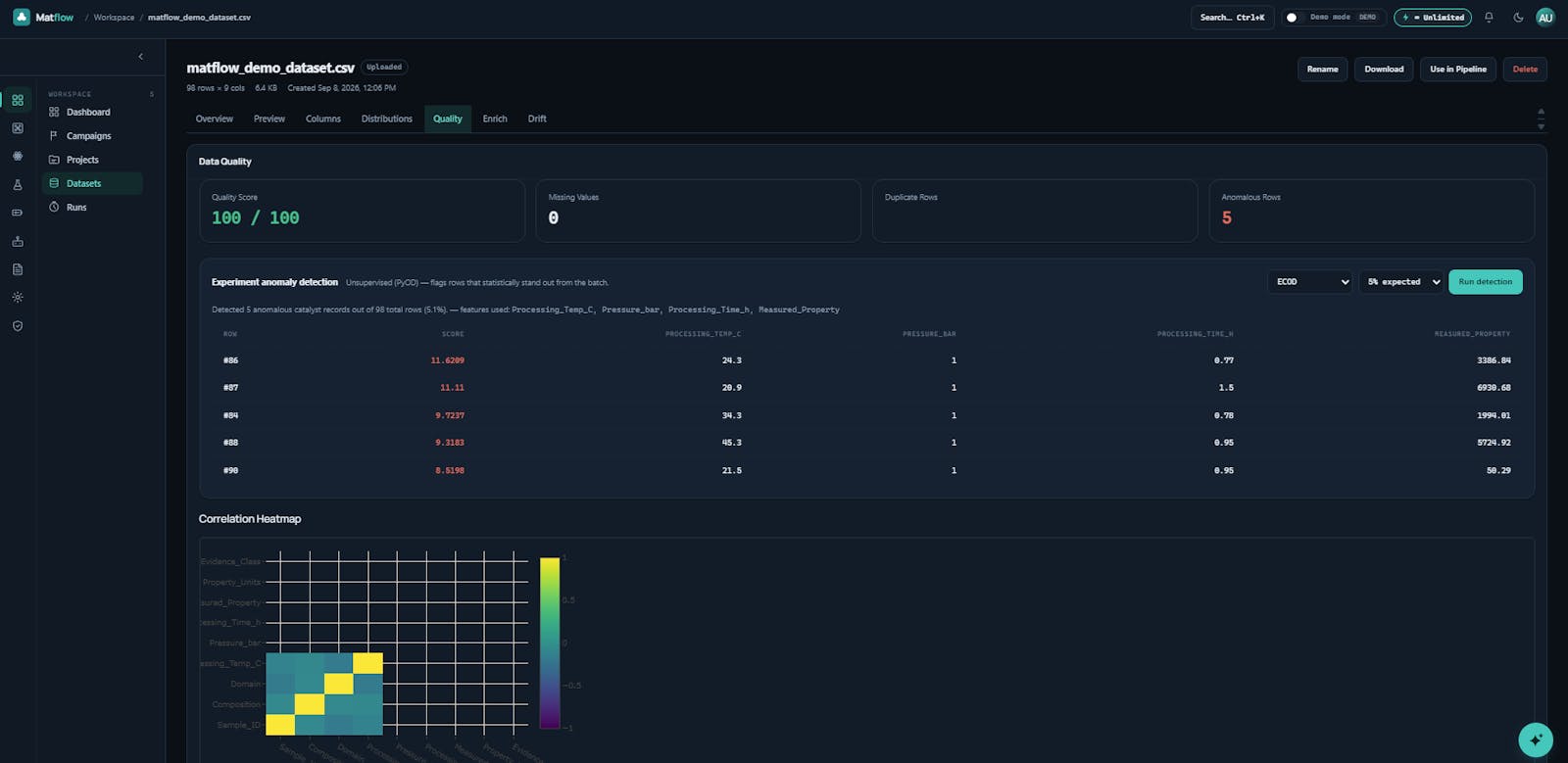
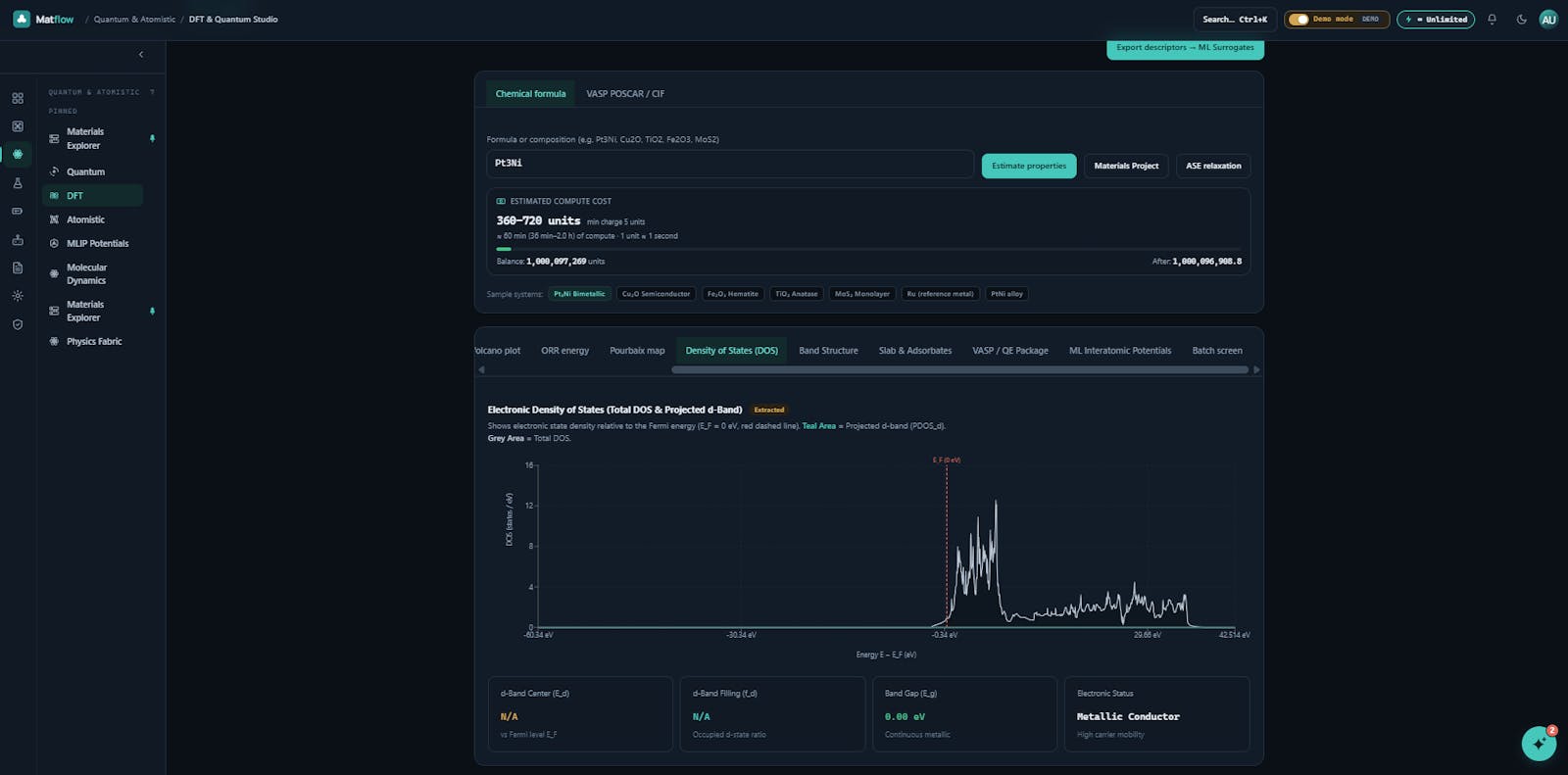
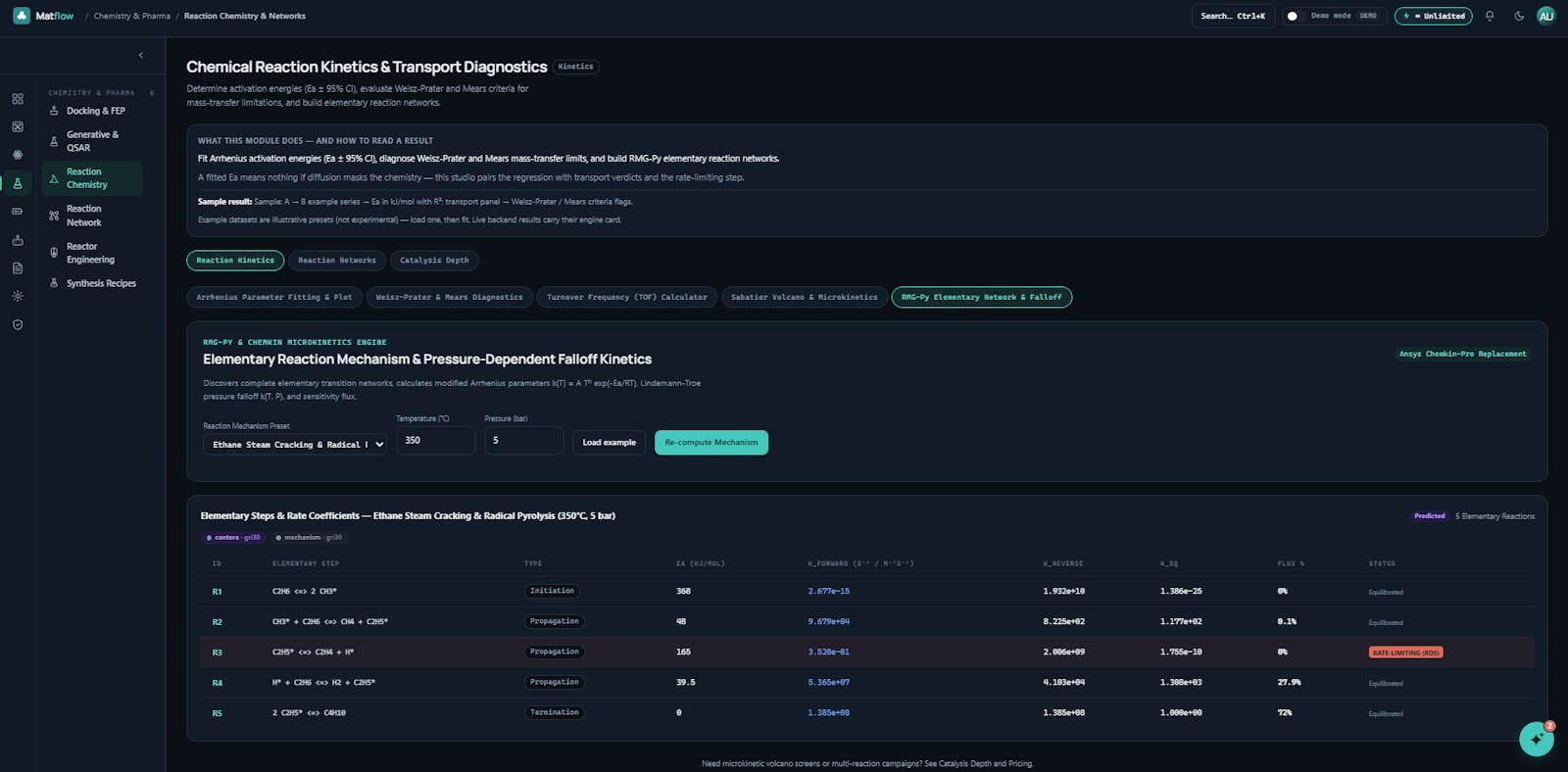
Matflow
Why it matters.
A typical R&D campaign produces tens of rows, not millions — and most AI tooling quietly assumes the opposite. Matflow is built for that reality: it ingests CSV, Excel, PDF, and instrument files, checks and maps the columns, and moves the data through augmentation, modelling, optimization, and techno-economics without ever pretending a guess is a measurement.
Every number on the platform carries an evidence class — MEASURED, COMPUTED, PREDICTED, EXTRACTED, HYPOTHESIS, or DEMO — and an engine card naming the engine, version, license, and limitations behind it. Reproducibility bundles ship with the results, so a dossier can survive publication review.
Capabilities
What it does.
- Upload CSV, Excel, PDF, or instrument files — XRD, GC/MS, FTIR, NMR, battery cyclers — with automatic column mapping, unit extraction, and QC review.
- Generative augmentation (Neural GAN, Hybrid GAN + copula, or Statistical) audited by 20+ quality, privacy, and distribution metrics before it reaches a model.
- Five-model ensembles with SHAP/LIME explanations, split-conformal prediction intervals, and explicit extrapolation flags.
- Multi-objective optimization (adaptive and evolutionary search) with TOPSIS ranking and true Pareto fronts under 100% sum constraints.
- Integrated techno-economics: raw materials, equipment, CapEx/OpEx, and end-of-life cost in a single net-value objective.
- Physics engines including PyBaMM, M3GNet, and pycalphad when available — with labelled analytic fallbacks when they are not.
- Domain studios for batteries and energy, formulations and CASE, polymers, alloys, molecular screening, and reaction kinetics.
- Self-hosting via Docker, ONNX/joblib model export, OPTIMADE v1.2 interoperability, RO-Crate bundles, an MCP server, and an Opentrons closed-loop workflow.
Pricing
Start free, or join as a Founding Lab.
Free
Free and academic tiers — every module included.
$99/mo
Starter — monthly or annual billing.
$349/mo
Pro — monthly or annual billing.
$999/mo
Enterprise — monthly or annual billing.
The first ten labs onboard as Founding Labs at $79/month locked for life, and academic use is free. Launched on Product Hunt in September 2026.
Paid plans renew monthly or annually until cancelled. Cancel any time from Settings → Billing. Refunds are available where required by law.
Every module is included in the free account.
Free accounts include every module. Academic researchers with institutional email domains get extended limits automatically.