Skip to content

Portfolio — AI engineer & founder

Bassil Elshenawy

I build AI systems for science and medicine — from research prototype to deployed product. Founder of Celaron, the company behind Matflow and CAPRI, with research roots at QCRI, QEERI, and QSTP.

Open to Summer 2027 internships

FOUNDER, CELARON · BENG ARTIFICIAL INTELLIGENCE · GPA 4.0

Bassil Elshenawy, Founder & CEO of Celaron
Founder & CEO, Celaron.

Selected work

Five projects, documented.

Startups, a research audit, a research platform, and client work. Each entry covers the problem, what I built, and the numbers behind it.
Research papers

01 — Startup · Celaron · scientific R&D

2025 — present

Matflow

Live

Founder & platform architect

Experimental rows in, ranked candidates out.

Matflow is an AI-native operating system for chemistry and materials R&D. It takes sparse experimental data from instruments, ELNs, and spreadsheets, checks and models it, and returns cost-aware candidate rankings and next experiments — with every number traceable to its source run.

What I built

  • Designed and built the product end to end: ingestion, data synthesis, five-model ensembles with conformal intervals, multi-objective optimization, techno-economics, and reporting.
  • Built the evidence layer — six evidence classes, engine cards, reproducibility bundles, and hash-chained audit logs — so a prediction can never quietly become a measurement.
  • Connected candidate selection to lab execution with Opentrons automation, an LLM copilot, and MCP tools.
  • Shipped the commercial platform: self-serve billing, an academic tier, a 36-module workflow, a public benchmarks hub, and Docker self-hosting.

36

Workflow modules

0.41–0.95

Held-out R² on public benchmarks

6

Public gold suites

$99/mo

Self-serve, free academic tier

Stack: React 19 · Flask · PostgreSQL · Redis + Celery · Docker · PyBaMM · M3GNet · pycalphad

Metrics published on matflow.celaron.com and its public benchmarks hub.

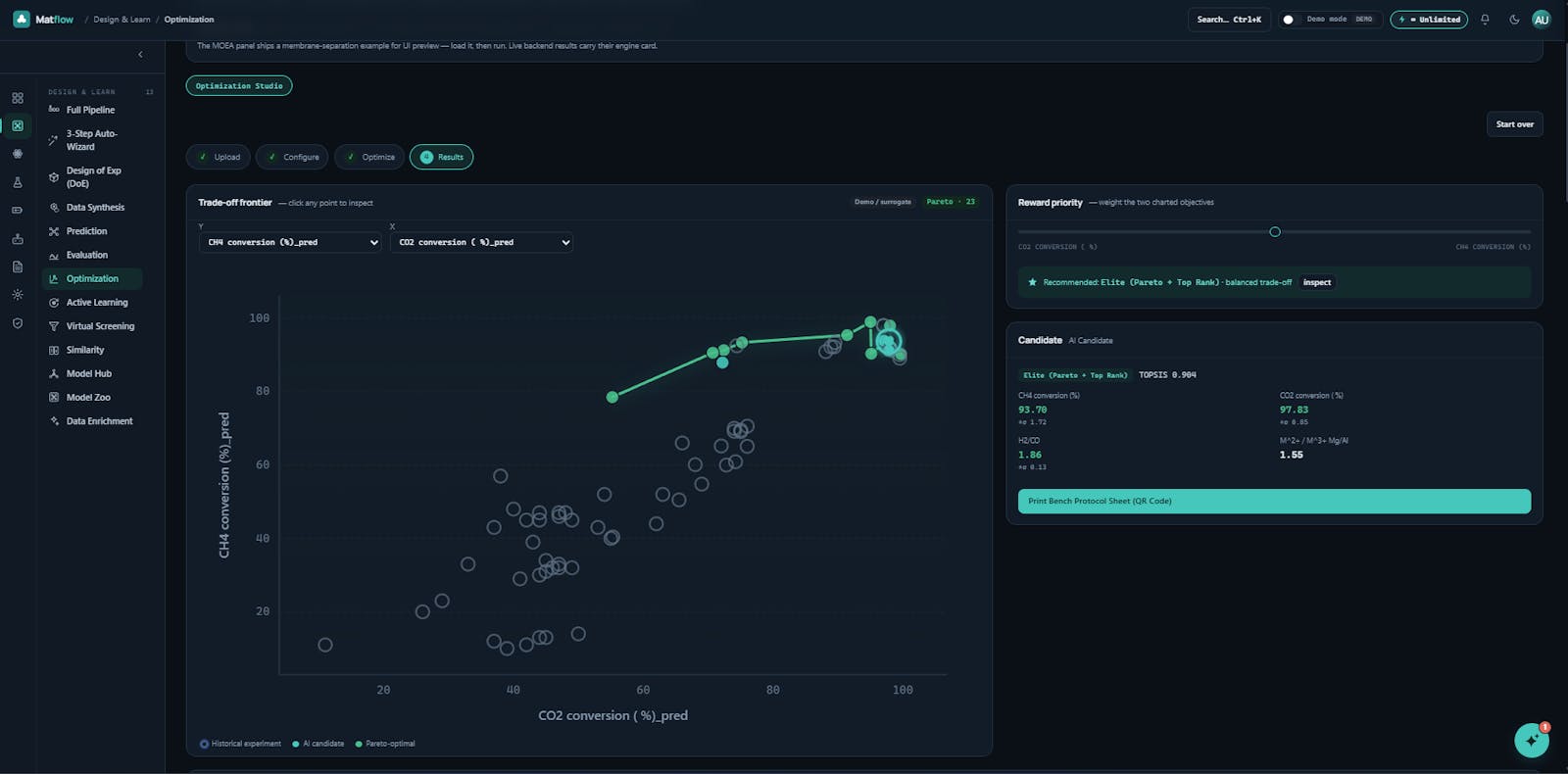
Matflow Optimization Studio showing a Pareto frontier of candidates with conformal intervals
Optimization Studio: predicted conversion against cost, with a Pareto frontier, conformal intervals, and TOPSIS-ranked candidates.

02 — Startup · Celaron · precision oncology

2026 — present

CAPRI

Live · research use only

Engineering — application & AI

Evidence-ranked variant interpretation in one workbench.

CAPRI — Cancer Actionability & Precision Response Interpreter — unifies twenty-nine biomedical sources into one research workbench: normalized variants, AMP/ASCO/CAP-style Tier I–IV actionability, structure-aware protein–drug interpretation, cohort analytics, drug and trial intelligence, and de-identified tumor-board reports. It began during a QCRI/HBKU Precision Medicine internship and is now operated by Celaron.

What I built

  • Built the application and AI layer: variant normalization, transparent evidence ranking (AMP/ASCO/CAP Tier I–IV), conflict detection, structure-aware protein–drug interpretation, cohort analytics (OncoPrint, TMB, co-occurrence, pathway enrichment), and report generation.
  • Built a mutation–drug simulator with AutoDock Vina docking, structure-aware exploration, and de-identified tumor-board PDF reports for research use.
  • Took the intern project to a deployed product: authentication, research-use controls, a public API, and a live catalogue.

510,504

Variants in the live catalogue

1,084

Genes in the live catalogue

2,436

Drugs with target context

29

Integrated biomedical sources

Stack: React 18 · FastAPI · SQLAlchemy · RDKit · NGL.js · SQLite/PostgreSQL · Docker

Research use only. Counts read live from the CAPRI API on 25 October 2026.

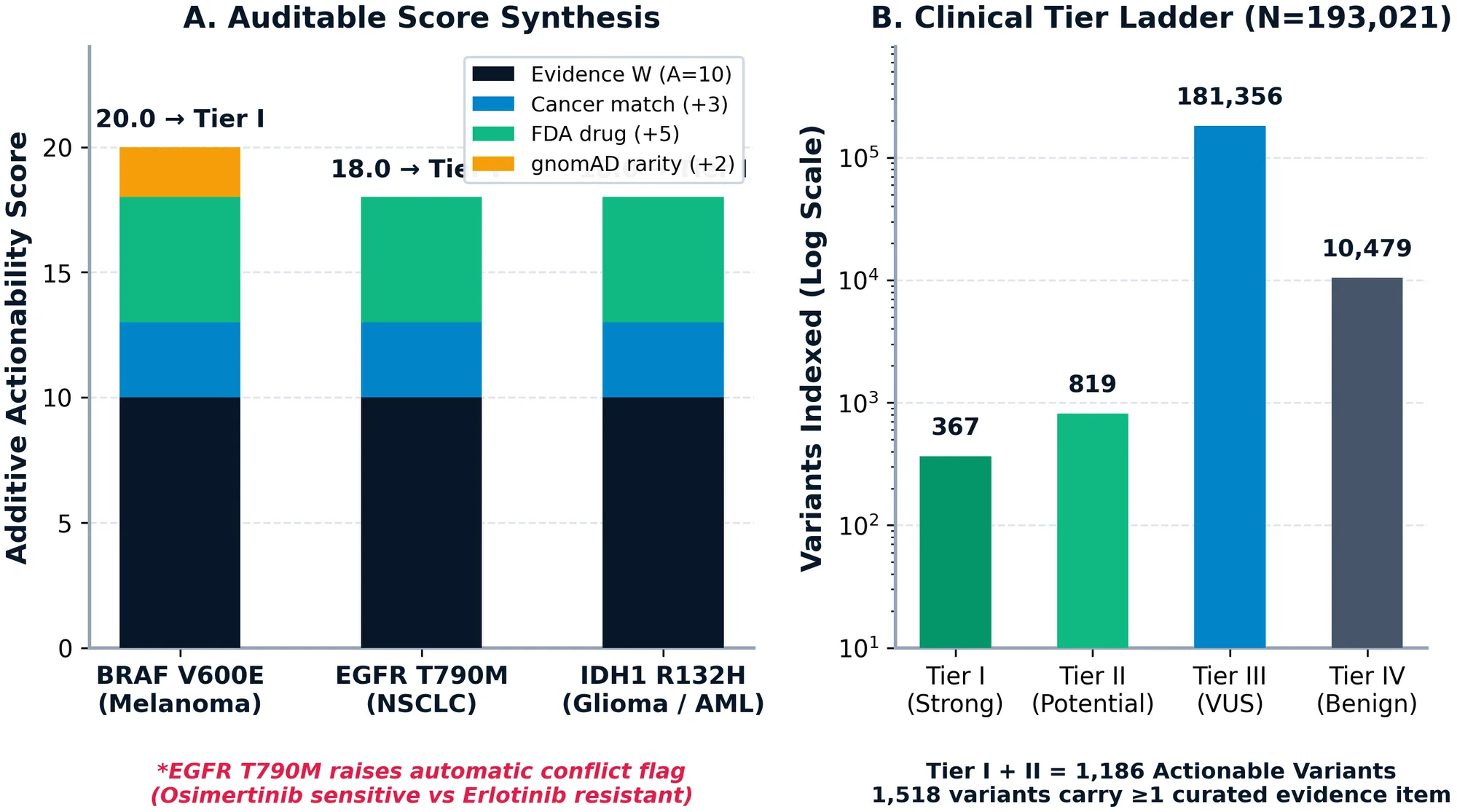
CAPRI AMP-style tier ladder and auditable score synthesis chart
CAPRI's AMP-style tier ladder on the original QCRI/HBKU research snapshot (193,021 variants). The live catalogue now holds 510,504.

03 — Research audit · QCRI · continual learning

2026

CMM audit

Working manuscript · 2026

Lead author of the audit (with A. Baggag)

Why lower forgetting can mean weaker learning.

An order-aware diagnostic audit of a published continual-model-merging pipeline. The work asks whether the headline metric — final average accuracy — hides a trade-off between learning new tasks and retaining old ones.

What I built

  • Built a 10×10 accuracy-matrix harness that saves every post-merge checkpoint and computes learning accuracy, backward transfer, and forgetting — not just a final average.
  • Ran a 27-run grid across three merge schedules, three seeds, and three task orders, plus EWC, naive, joint, and independent-Fisher anchors — roughly 235 GPU-hours on one RTX 4070.
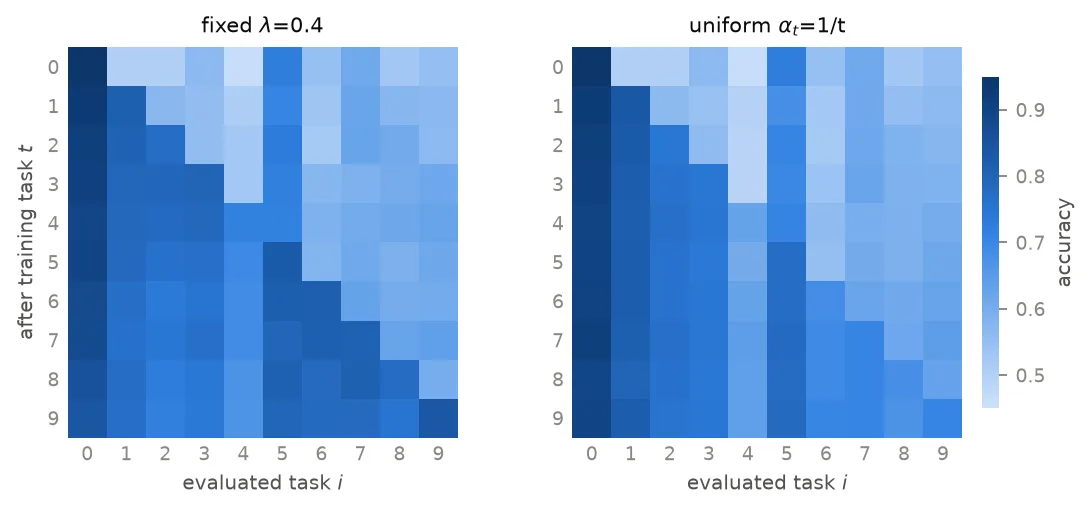
  • Found that uniform α = 1/t cuts forgetting 3.4× but costs 5.57 pp of learning accuracy; decomposed the trade-off and showed that Fisher-proxy scale acts as an implicit merge coefficient.

3.4×

Lower forgetting (FM 0.054 → 0.016)

27

Runs · 3 schedules × 3 seeds × 3 orders

55

Archived 10×10 accuracy matrices

235

GPU-hours on one RTX 4070

Stack: PyTorch · OpenCLIP · torch.func · NumPy / SciPy · Matplotlib · LaTeX

Working manuscript: Acquisition, Retention, and Fisher-Proxy Scale in Continual Model Merging. Independent audit of Phan et al. (2025), arXiv:2509.23592 — I am not an author of the original paper.

Two 10 by 10 accuracy matrices comparing fixed and uniform continual model merging
Post-task accuracy matrices: fixed λ = 0.4 (left) versus uniform α = 1/t (right). Figure from the audit.

04 — Research platform · QCRI · catalysis

May — Oct 2025

CatForge

Live · paper in submission

Founding contributor · first author on the system paper

Catalyst design from sparse lab data, end to end.

CatForge is a browser platform for small-data heterogeneous catalysis. Teams upload a dataset, generate physically plausible synthetic rows, audit them, train interpretable predictors, and optimize candidates under cost and performance constraints.

What I built

  • Built the core synthesis, evaluation, and prediction architecture: Copula/GAN augmentation, XGBoost/RF ensembles, and SHAP/LIME explanations.
  • Built the end-to-end workflow — roles, admin, usage limits, visualizations, an AI assistant — and the constrained Pareto/TOPSIS optimization studio.
  • First author on the system paper; validated across four datasets and three matched laboratory cases.

4

Datasets, 10–1,831 rows

71.8–78.2%

Aggregate synthetic fidelity

0.3–6.8 pp

Lab conversion agreement

52

Automated tests

Stack: Flask · React 19 · SDV · XGBoost · Optuna · SHAP / LIME · Docker

System paper in submission; no DOI yet. Metrics are from the final manuscript.

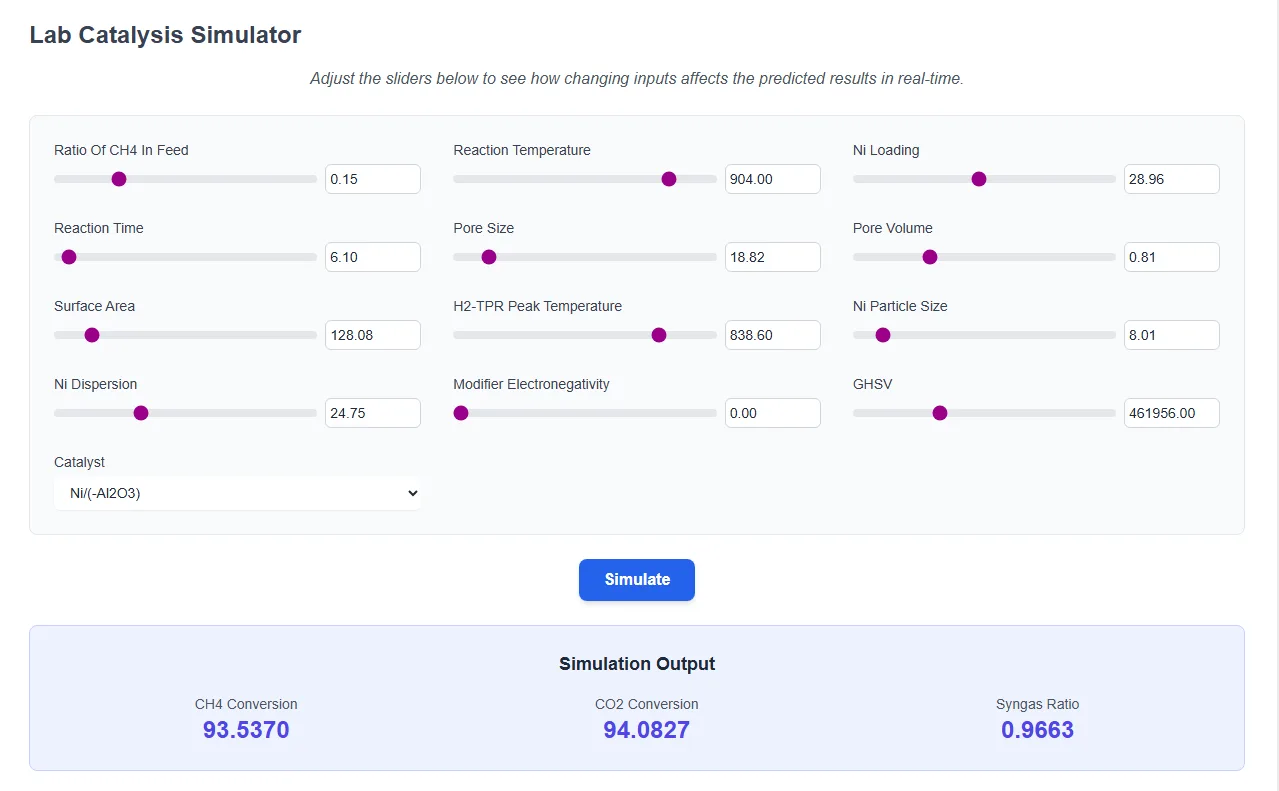
CatForge Lab Catalysis Simulator interface with input sliders and predicted outputs
CatForge's Lab Catalysis Simulator: adjust experimental inputs and see predicted conversion and syngas ratio in real time.

05 — Client website · shenawy.group · Doha

2026

MEG

Live · client work

Design & build

A bilingual flagship site for a Doha furniture house.

MEG is a furniture and interior-design business in Doha. I designed and built its Arabic-first website end to end: a 613-product catalogue, projects, atelier story, material library, and consultation flow, with a full English mirror.

What I built

  • Designed the visual system and built 27 pages in Arabic (RTL) and English, with localized metadata, JSON-LD, and a 638-image product library.
  • Built the catalogue experience: category and subtype filters, bilingual search, URL state, quick view, and a signature-chairs carousel.
  • Built the lead pipeline: a Flask API with Cloudflare Turnstile, honeypot, SMTP alerts, SQLite/CSV storage, a protected admin dashboard, and a Cloudflare → nginx → systemd deployment.

613

Categorised products

27

Pages across two languages

638

Product images

2

Full language versions

Stack: HTML / CSS / JS · Flask · SQLite · Cloudflare · nginx · systemd

Client work for MEG, Doha. Site imagery © MEG.

MEG interior with a carved fireplace, piano, and classic furniture
MEG showroom interior, Doha. Site imagery supplied by MEG.

Additional work

More projects, smaller surface area.

Two QEERI internship contributions, a live chat deployment, and an in-development inference product.

Benchmark

Paper under submission

C2

C2CAD-BENCH

QEERI · Contributor — QEERI internship

A code-free benchmark for 3D spatial reasoning: models return JSON CAD primitives and a deterministic scorer checks coverage, geometry, and semantic validity across 25 test families.

75 cases · 13 models (paper snapshot)

QEERI internship project. I am a contributor, not the founder.

Research pipeline

Live · experimental

TQ

ThinQA

QEERI · Contributor — QEERI internship

An LLM-driven biomimicry pipeline that turns prompts into PicoGK geometry and validates it through a three-layer MCP/JSON-RPC loop — achieving a 100% watertight mesh output rate and under-six-minute generation for evaluated gyroid-catalyst and vascular heat-sink cases.

100% watertight · under 6 minutes

QEERI internship project. I am a contributor, not the founder.

Product deployment

Live

CC

Celaron Chat

Celaron · Deployment & customization

A private, self-hosted AI workspace built on Open WebUI and customized with Python and Svelte: email and Google sign-in, document and image support, and per-user access control.

Open WebUI · chat.celaron.com

Infrastructure

In development · local beta

CI

Celaron Inference

Celaron · Creator & engineer

An OpenAI-compatible inference router with 12 model routes, API keys, credit metering, Stripe billing, a usage dashboard, and an admin console. Built and tested locally; not yet public.

12 model routes · 23 endpoints

Documents

Posters & artifacts.

The research posters behind the CMM audit and the CAPRI workbench.

About

I build tools that show their work.

Every company has an origin story. Mine is a pattern I could not unsee.

During my research internships at QCRI and QEERI, I kept running into the same pattern: a model prediction, a literature value, and an instrument measurement all arrived on screen looking identical. The tools were confident either way, so people had to judge how much to trust a number from memory and intuition.

I founded Celaron to build the opposite. Matflow tags every value with an evidence class — MEASURED, COMPUTED, PREDICTED, EXTRACTED, HYPOTHESIS, or DEMO — and names the engine and version behind it. CAPRI ranks what it finds by curated clinical evidence, so a Tier I finding is never buried under speculation.

Outside Celaron I have contributed to research projects at QCRI and QEERI, including the CatForge catalyst platform and a diagnostic audit of a continual-model-merging pipeline, and client websites like shenawy.group. The common thread is the same: make the thing usable, and make its claims legible.

Experience

Where I have done the work.

Four research and engineering roles across QCRI, QEERI, and QSTP — the work behind the platforms and the papers.
  1. Oct 2025 – Apr 2026 · Oct 2026 – Present

    GenAI Research Intern

    Qatar Environment and Energy Research Institute (QEERI)

    • Contributed to the ThinQA LLM-driven biomimicry design pipeline for autonomous 3D geometry generation and validation.
    • Helped build a three-layer MCP / JSON-RPC architecture for STL validation, GPU-accelerated rendering, and automated feedback — producing watertight meshes in evaluated gyroid-catalyst and vascular heat-sink cases in under six minutes.
    • Benchmarked geometric accuracy, manufacturability, and functional performance; contributed to the C2CAD-BENCH benchmark and manuscript.
  2. May 2026 – Jul 2026

    GenAI Research Intern — Continual Learning

    Qatar Computing Research Institute (QCRI)

    • Built an order-aware 10×10 accuracy-matrix harness for continual model merging, computing learning accuracy, backward transfer, and forgetting across post-merge checkpoints.
    • Ran a 27-run audit (3 merge schedules × 3 seeds × 3 task orders) plus EWC, naive, joint, and independent-Fisher anchors on split CIFAR-100, using ~235 GPU-hours on one RTX 4070.
    • Found that uniform α = 1/t cuts forgetting 3.4× (0.054 → 0.016) while lowering final accuracy 1.74 pp, and decomposed the trade-off into a 5.57 pp acquisition deficit and a 3.83 pp retention gain; led the manuscript and A1 poster with QCRI collaborators.
  3. May 2025 – Oct 2025

    GenAI R&D Intern & Founding Contributor

    Qatar Computing Research Institute (QCRI) — CatForge

    • Built core synthesis, evaluation, and prediction components for the CatForge catalyst-design platform, integrating Copula/GAN data generation with XGBoost/RF predictive ensembles.
    • Implemented user roles, admin dashboards, usage limits, scientific visualizations, an AI assistant, and the end-to-end optimization workflow.
    • Added SHAP/LIME interpretability, redesigned the optimization interface, and became first author on the CatForge system paper (in submission).
  4. Jun 2024 – Oct 2024

    GenAI Developer

    Qatar Science and Technology Park (QSTP)

    • Developed computer-vision pipelines for real-time detection and anonymization of individuals in video streams.
    • Optimized video-processing and blurring workflows, and documented algorithms and technical specifications for the team.

Toolkit & foundation

What I build with, and where I learned it.

AI / ML

  • Generative AI
  • LLM fine-tuning
  • Continual learning
  • PyTorch
  • GANs
  • XGBoost
  • SHAP / LIME

Software

  • Python
  • Flask / FastAPI
  • React
  • SQLAlchemy
  • PostgreSQL
  • Docker
  • pytest
  • MCP

Scientific computing

  • Cheminformatics (RDKit)
  • Molecular docking
  • Uncertainty quantification
  • Multi-objective optimization

Sep 2023 – expected May 2027

BEng in Artificial Intelligence

Ulster University

GPA 4.0. Coursework: artificial intelligence, database systems, software development, user experience, and object-oriented programming.

Sep 2019 – Jun 2023

High School Diploma

Edison International Academy

MOEHE equivalency 91.29%. AS Levels in mathematics, computer science, and Arabic; 8 IGCSEs including mathematics, computer science, ICT, physics, and chemistry.

Institutions

Research and study across QCRI, QEERI, QSTP, and Ulster University.

  • Qatar Computing Research Institute
  • Qatar Environment and Energy Research Institute
  • Qatar Science & Technology Park
  • Ulster University

Institutions where I have worked or studied. All trademarks belong to their owners.

How I work

Four rules I do not break.

The AI industry is full of claims. I would rather be boring and correct than exciting and wrong.

01

Evidence over hype

Every claim our platforms make carries a provenance trail. Numbers are labelled MEASURED, COMPUTED, PREDICTED, EXTRACTED, HYPOTHESIS, or DEMO — and nothing fake is ever presented as real. That rule applies to our own marketing, too.

02

Open by default

We build on open standards and open-source science engines. Data is exportable, models are portable, and the platforms can be self-hosted — because the people doing the work should own the work.

03

Human in the loop

AI accelerates decisions; humans make them. Our platforms are designed with approval gates, audit trails, and safety interlocks at the steps where being wrong is expensive.

04

Small data is the real world

Most scientific teams have tens of experiments, not millions of rows. We build for sparse, expensive, hard-won data instead of pretending everyone has internet-scale datasets.

Contact

Let's build something that holds up.

Summer 2027 software and AI engineering internships are my priority right now — especially applied AI, evaluation infrastructure, and developer tools. I am also open to research collaborations and product work. I read every message.

For product help, email support@celaron.com.