The problem
A cancer genome arrives as variants scattered across dozens of registries, each with different identifiers, evidence levels, and blind spots. Reconciling them is slow, and the ranking is where interpretation actually happens.
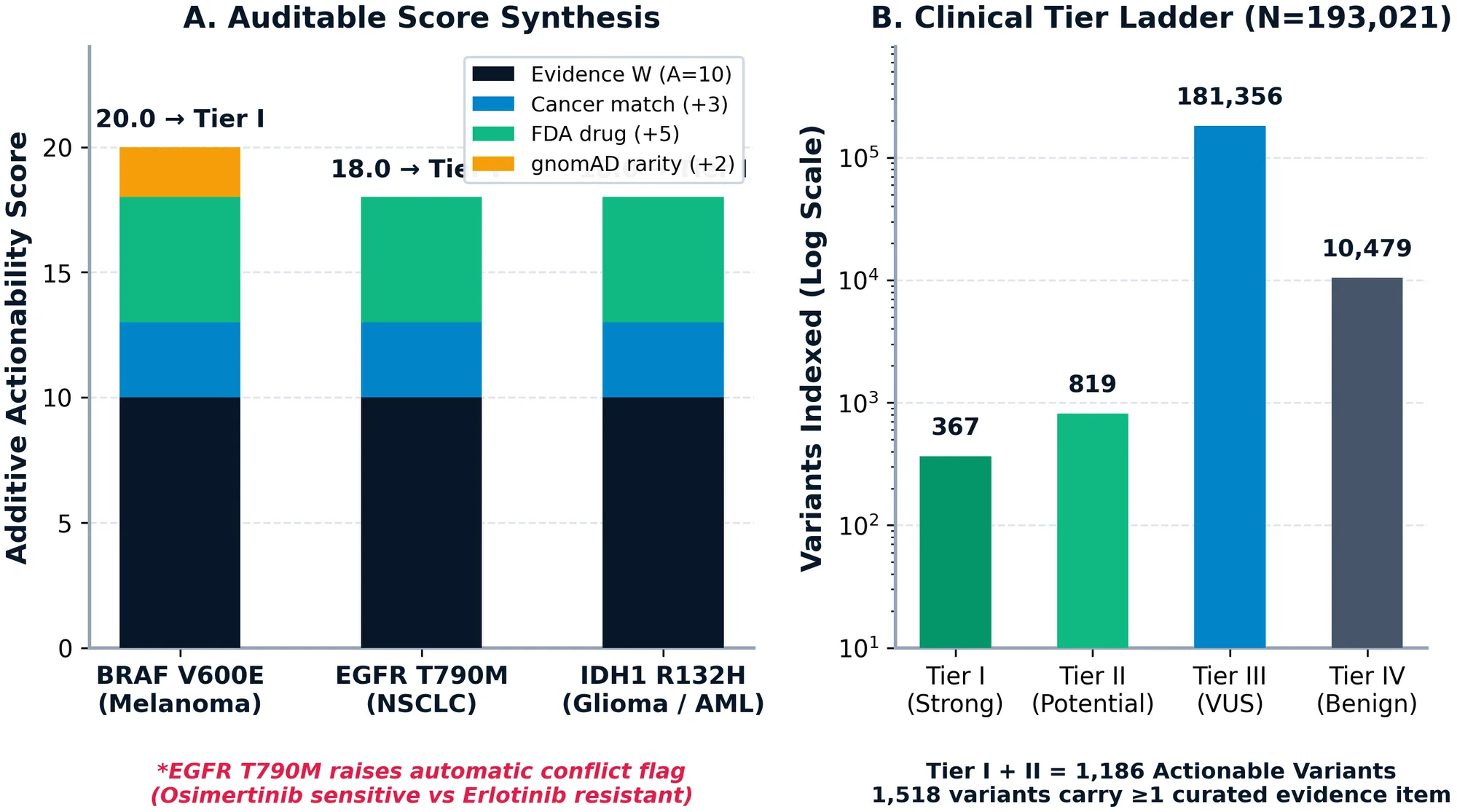
A Tier I finding can disappear under 180,000 Tier III variants if the interface treats every row the same. Conflict detection and structure context are not decoration; they are how a researcher decides what to trust.
What I built
During a Summer 2026 internship with QCRI / HBKU Precision Medicine, I built the application and AI layer of CAPRI: a FastAPI backend and React workbench that normalizes variants, attaches curated evidence, ranks actionability, and produces reports.
- Variant normalization and transparent evidence ranking across AMP/ASCO/CAP Tier I–IV.
- Conflict detection and structure-aware protein–drug interpretation.
- A mutation–drug simulator with AutoDock Vina docking and pose output.
- Cohort analytics: OncoPrint, TMB, co-occurrence, the actionability funnel, and pathway enrichment.
- De-identified tumor-board PDF reports for research use, plus a grounded assistant that cites catalogue rows.
From internship to product
The research workbench became the product now live at capri.celaron.com. Sign-up is open, and the platform is explicitly research use only.
The original internship snapshot covered 193,021 variants across 768 genes. The live catalogue has grown to 510,504 variants, 1,084 genes, 2,436 drugs, and 29 integrated sources.
The work was presented as an A1 research poster at QCRI / HBKU.
What I learned
Provenance is the product. The moment a variant could be traced to its source and tier, researchers could move faster without lowering their guard.
Research-to-product is mostly a matter of constraints: authentication, access control, and honest 'not known' states. A workbench that admits uncertainty is more useful than one that hides it.