The problem
A typical materials R&D campaign produces tens of rows, not millions. Standard deep learning falls apart on data that small, and most platforms quietly ignore the problem — they demo on public benchmarks and leave the lab to reconcile the gap.
The bigger issue is epistemic. A model prediction, a literature value, and an instrument measurement can arrive on screen looking identical. If a team cannot tell which is which, every downstream decision inherits that ambiguity.
What I built
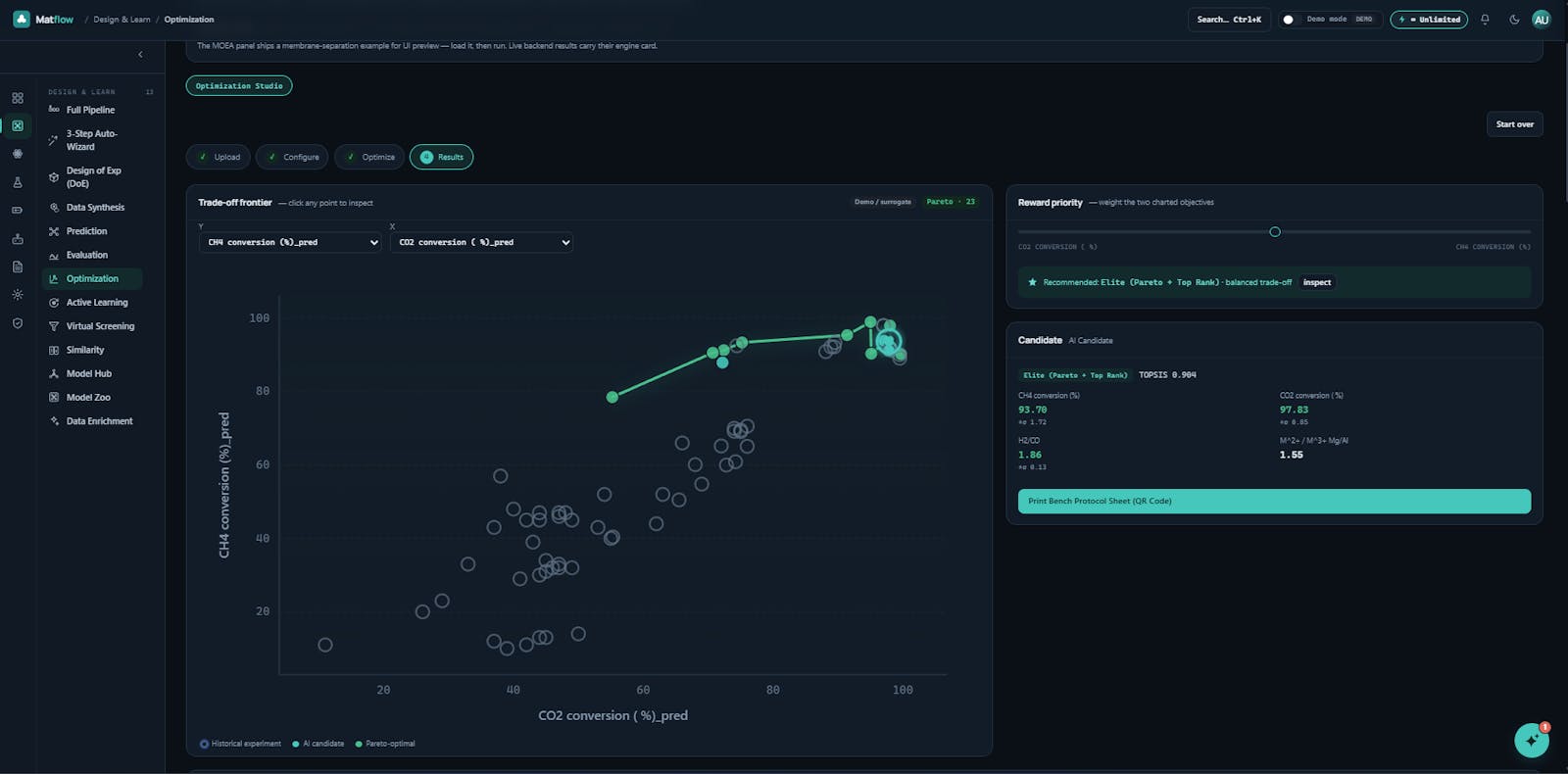
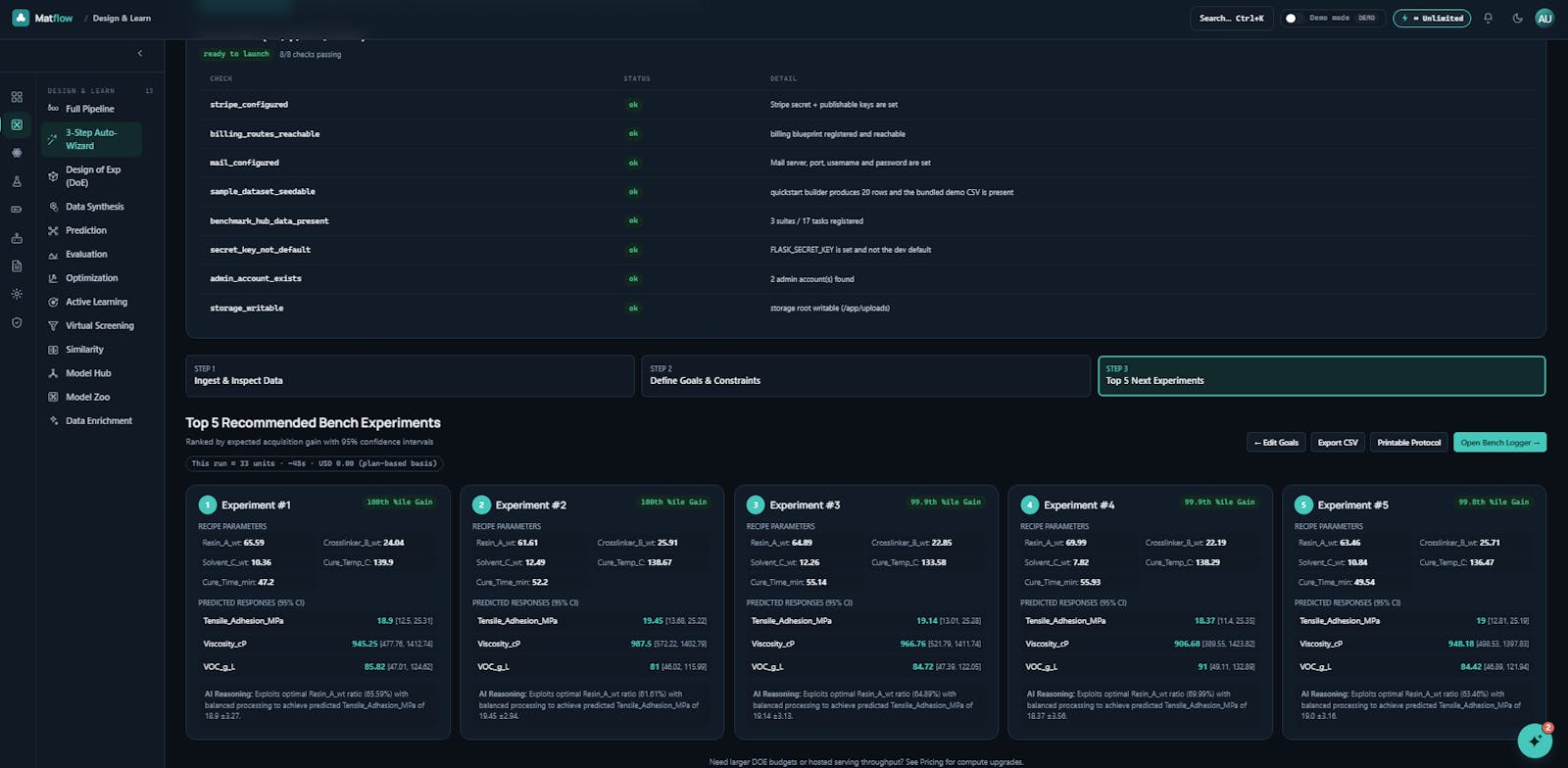
Matflow is the end-to-end answer: ingest and QC experimental data, synthesize additional rows in a way that can be audited, train interpretable ensembles with conformal intervals, optimize candidates against physics and economics, and package the result as a reproducible dossier.
- Data path: CSV, Excel, PDF, and instrument ingestion with column and unit mapping, QC, and Copula/GAN augmentation audited by 20+ fidelity and privacy metrics.
- Models: five-model ensembles with SHAP/LIME explanations, split-conformal intervals, extrapolation flags, and ONNX/joblib export.
- Physics and lab: PyBaMM, M3GNet, and pycalphad engines, Opentrons protocol generation, an LLM copilot, and MCP tools.
- Trust: six evidence classes, engine cards, hash-chained audit logs, reproducibility bundles, and publication dossiers.
- Delivery: self-serve billing, a free academic tier, Docker self-hosting, public benchmarks, and a typed Python SDK.
What the numbers say
Held-out R² across public benchmark datasets ranges from 0.41 to 0.95, with a leave-family R² of 0.95 on the bundled demo corpus. The platform ships 36 modules, six public gold suites, and four material systems validated against lab measurements.
Matflow launched on Product Hunt in September 2026 with self-serve pricing from $99/month, a free academic tier, and a Founding Labs programme for the first ten teams.
What I learned
The evidence label is a product decision, not a research afterthought. Once every number had to declare what it was, the interface, the export format, and the sales conversation all got simpler.
Self-hosting is a feature for scientific teams, not a checkbox. If a lab cannot run the software where its data lives, it will not trust the software with its data.